Thursday, 19 July 2012

How can the "flabby" public sector possibly compete with such ruthlessly efficient three-letter acronyms? All hail our private sector paymasters!


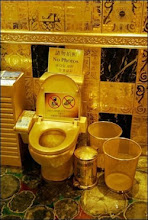
If the dignified, level-headed way G4S has handled London 2012 security has taught The Golden Latrine anything, it's that subcontracting out services that would normally fall under the public sector's remit to private 3-letter acronyms always leads to a sleeker, more efficient service.

W
hile cynics carped about the army and police having to be drafted in in their thousands to make up for shortfalls in the number of security guards provided by G4S, in a rational world the private security firm (sorry, "word's leading provider of security solutions") would have been applauded for allowing our brave boys to get in on the Olympic action. Yes, CEO Nick Buckles admitted that perhaps not all of the security guards provided by G4S would be able to speak English, but as the old adage goes: the baton is mightier than the vocal chords.

Likewise A4e, who did such a bang-up job in ushering our jobseekers back to work (and surely the point of work is the inherent dignity of labour, rather than actually getting paid?). And who could forget Capita-owned court interpreters ALS, whose minor "teething problems" in fulfilling their £300 Ministry of Justice contract have compassionately handed our nation's criminals a moment of respite when their trials collapse.

What else can the flabby public sector do when faced with such ruthless competency but genuflect in admiration of our corporate paymasters. God bless the private sector! May its efficiency savings be a shining example to us all!


Sunday, 1 July 2012

Was Vince Cable right to say banking was a "moral quagmire"? Or are the Barclays scandals really just the work of a few rogue traders?


The Golden Latrine can still clearly remember the pride he felt at setting up his first bank account. At the time it felt like a rite of passage into the adult world. Nowadays those au fair with the state of British banking might prefer to take the safe option and keep their money stuffed in a Hello Kitty pillow case under the bed.

It was perhaps naive, if not unreasonable, to hope that the greed, wishful thinking and excessive risk-taking which led to the banking crash in 2008 - an event, lest we forget, that came perilously close to derailing the entire global economy - might have taught the banking industry a lesson. Surely they would have no choice but to clean up their ways and embrace the need for tighter industry regulation, right? Wrong.

B
ankers have been under the cosh this week following two major scandals which demonstrate how completely the industry has failed to reform itself. The announcement that four high street banks had been involved in the mis-selling of complex financial products to 28,000 small businesses was dwarfed by the revelation that Barclays had received a £290m fine from regulators for participating in the rigging of the LIBOR (the daily rate set by the British Bankers' Association, governing how much it costs for London's banks to borrow from each other) and the EURIBOR (the same, but for lending between European banks). And in case this sounds like obscure inter-bank politics removed from the real world, consider this: these rates underpin contracts worth $350 trillion worldwide, while the Libor rate impacted on an estimated 250,000 British mortgage holders at any one time over the last decade.

B
usiness secretary Vince Cable penned a strongly-worded piece for The Observer on the need for greater regulation, accountability, and cultural change within the industry, as well as calling for the implementation of the Vickers report (which recommends that bank reinstate the traditional firewall between their commercial banking and investment banking arms, as well as being forced to maintain greater reserves of capital). But what was heartening is that this time the savaging wasn't just from the liberal press. The governor of the Bank of England, Mervyn King, and Lord Turner, chairman of the Financial Services Authority, joined the fray, with the latter decrying the City "culture of cynicism and greed that is quite shocking".

Barclays CEO Bob Diamond has been summoned to the Treasure select committee on Wednesday, although chances are he won't be sweating unduly. This is, after all, the m
an who, upon being questioned by the same select committee last year about the seemliness of him receiving an £6.5m bonus for 2010 despite woeful trading figures, memorably told them: "There was a period of remorse and apology for banks and I think that period needs to be over." This a mere two years after his bank narrowly avoided the need for nationalisation - although they did greatly benefit from the bailout of the other banks, as their former CEO John Varley acknowledged. Humility is not, I think it's fair to say, Diamond's strong point.

And the revelations continue to flow. 
In a fascinating blog posted today, the BBC's Robert Peston revealed that managers at Barclays believed they had the Bank of England's tacit approval to manipulate the Libor rate - based on reports of a phone call between Bob Diamond and Paul Tucker, deputy governor of the Bank of England. Tucker firmly denies that he authorised any such thing.

Whatever the results of Diamond's appearance in front of the select committee, what is becoming brazenly clear is that these are not isolated incidents. 
As The Guardian's Jonathan Freedland wrote: 
Just as News International's insistence that phone hacking was confined to a few "rogue reporters" has been revealed as a lie, the idea that a small number of Bollinger-swilling renegades operated unnoticed inside our great British banks is absurd.
Freedland is spot on. This isn't about a few traders overstepping the mark, but yet further evidence of a wanton disregard for rules and regulations within the banking industry. RBS today revealed that they sacked four traders between November 2011 and February 2012 over their alleged involvement in attempts to fix the Libor rate, and there's a sense that the banking profession has been protected from widespread public scrutiny in the past by virtue of its jargon-heavy impenetrability. In other words, whereas anyone can understand a newspaper paying a private investigator to tap the telephone of a dead child's parents, a large percentage of the population are simply too bored by the minutiae of banking to scrutinise the actions of bankers in any detail.

Now, though, there's a definite sense of the veil lifting. Barclay's chairman Marcus Agius has fallen on his sword, Bob Diamond is under pressure to follow suit and V
ince Cable is calling for a criminal investigation into the inter-bank rate fixing. For too long the banking industry was given free reign as long as it continued contributing to British GDP on such a lavish scale. The time has come to regulate the banking system properly, but it isn't going to be easy. Our financial sector has the best lobbyists in the game, and incredible access to Downing Street. The lobbyists have already watered down the Vickers report, let's make sure our politicians don't let them dilute it any further.

Tuesday, 26 June 2012

"Compassionate Conservatism" was always a hollow phrase. With the welfare state now firmly in Cameron's crosshairs, should we be thankful for the Lib Dems?


Deep in his insalubrious past, The Golden Latrine claimed housing benefit for a period. The shame stills gnaws at his innards on a daily basis.

In a widely trailed speech delivered in Bluewater shopping centre in Kent yesterday, Cameron indulged in a spot of what his former sidekick Steve Hilton would no doubt have referred to as blue sky thinking. It was, he said, "time we asked some serious questions about the signals we send out through the benefits system," which is apparently encouraging a "culture of entitlement". The Golden Latrine would like to point out is in no way ironic coming from an alumni of Heatherdown Preparatory School and Eton, who is heir to a large personal fortune and was apparently given a helping hand into Conservative Central Office by a call from Buckingham Palace.

Among the ideas floated in the speech was a £20,000-a-year cap on housing benefit, a drive to make people on incapacity work harder at not being ill, and my personal favourite, the scraping of 
access to housing benefit for people under 25 - all with the aim of lopping £10bn off the welfare budget.

Tim Leunig from the liberal CentreForum thinktank was quick to debunk Cameron's ideas on scraping housing benefit for under-25s, rightly pointing out that simply building more public housing would reduce the government's housing benefit bill by forcing spiralling rent costs down (and, he might well have added, creating a large number of much-needed construction jobs). The speech did, needless to say, go down a storm with Golden Latrine favourite Melanie Phillips, who hailed Cameron's "important, bold and radical welfare reforms."

However, it should be stressed that this speech wasn't a set of policy directives but rather an attempt to discuss the "principles of debate," as work and pensions secretary Iain Duncan Smith put it, adding: "
The details of these, of course, we have to be careful about. We have to be sensitive to the different reasons people have housing - people coming out of care, being in difficulties in foster care." It was, in other words, a transparent attempt to woo back the Tory hardline (although interestingly, a poll on the Daily Mail showed that a massive majority of their readership were against the under-25s idea - clearly Tories aren't overly enamoured with the idea of having to house their ageing offspring either). Openly admitting that these were ideas for a post-2015 Tory government, what the PM was ultimately saying was: "This is what I would do, folks, if only I didn't have to accommodate those pesky Liberals in the Coalition. Vote for us outright next time."

With Cameron a distant dot in Labour's rear window in the polls, his desire for eye-catching reforms is understandable. But if he really wants to cut costs, he should perhaps look closer to home. According to a report from The Guardian's Patrick Wintour, the Treasury has already accepted that the current creation of Universal Credit (which basically just merges benefits and tax credits into one system) will cost the government money, rather than create savings.

For now these policies remain voter-wooing pipedreams, but if we get a majority Conservative government in 2015, there might well be a large number of graduates moving back home with their parents. 
In a peculiarly nasty article  in the Observer a few weeks back, Barbara Ellen opined that anybody still living with their parents at the age of thirty should "get a life". It might be time for her to take another look at that one. 

Saturday, 9 June 2012

Are less well-off voters who vote Conservative just suffering from "false consciousness"? Or is the Right just better at talking about values?


Back in the days before he became a jaded roue, committed to a life of Tesco Cava breakfasts and loose women, The Golden Latrine used to get himself into a right old tizz over the idea of people voting for politicians because they were, quote unquote, "a strong leader".

The most famous domestic example of recent times was, of course, Margaret Thatcher. Watch footage of voters during her election campaigns, and you hear the same view expressed time and time again: she's a strong leader, even if I don't agree with all her policies. As a feisty young politico, this struck me as an inherently flawed outlook. Surely the worst possible combination you can have in a Prime Minister is an iron-willed leader who will enact the policies you're against with the utmost vigour. David Cameron has wreaked enough damage already, despite the fact he supposedly spends half his waking hours "chillaxing".

No, as far as I was concerned, the only reason the less well-off ever voted Tory was that old Marxist chestnut: false consciousness. If only the working class voters knew the truth, they would have no choice but to vote Labour (see this New Internationalist blog, which brands a working class Tory vote as "nothing short of a betrayal," as a shining example of this kind of thinking). Now, though, this position strikes me as fundamentally unsound. 

Jonathan Haidt's new book, The Righteous Mind: Why Good People are Divided by Politics and Religion, examines this the question of why the working class frequently vote against what are, seemingly, their own economic interests. Why, for instance, was Ronald Reagan such an unstoppable hit with America's blue-collar workforce? Why did so many British working class families embrace Thatcherism? Was it simply  a sense of misplaced loyalties?

Haidt's conclusion, as he outlined in an article for The Guardian, is that the right are frequently better at articulating a moral vision for the nation, whereas the left is prone to over focusing on policies: there will be this many more NHS beds; we will lift this many people out of poverty. All very progressive and praiseworthy, but lacking an emotional pull - an important factor in politics, as The Golden Latrine has written about before. As Haidt put it:
It's more about a moral vision that unifies a nation and calls it to greatness than it is about self-interest or specific policies. In most countries, the right tends to see that more clearly than the left. In America the Republicans did the hard work of drafting their moral vision in the 1970s, and Ronald Reagan was their eloquent spokesman. Patriotism, social order, strong families, personal responsibility (not government safety nets) and free enterprise. Those are values, not government programmes.
There's still a portion of the left that has an extremely unfortunate tendency to treat the poor as an anthropological specimen, dismissing legitimate concerns about things like immigration or Islamic extremism. The poor are seen as noble savages, mislead by their lack of education, bless their hearts. As a result of ignoring these concerns, a lot of current left-wing thinking falls foul of an obsession with tolerance and what Slavoj Zizek calls the "culturalisation of politics", which he describes as the process whereby:
political differences, differences conditioned by political inequality, economic exploitation, etc., are naturalized/neutralized into "cultural" differences, different "ways of life," which are something given, something that cannot be overcome, but merely "tolerated.
What Zizek is really talking about is the retreat of politics, it's abdication of the idea that it can fundamentally change the way our society is configured. For example, the existence of a glaring disparity in living standards between the extremely wealthy and the extremely poor is no longer something to be challenged, only managed - encapsulated perfectly by Peter Mandelson's famous declaration about New Labour being "intensely relaxed about people getting filthy rich". The naked greed of much of the banking sector and the mega bonuses they receive are not obscene byproducts of a fundamentally unjust system that needs to be redrawn, but simply a fact of life. They can no more be challenged than a law of nature can. Hence four years after the banking crash which threatened to destabilise the entire world economy, many of the major players are back to their old ways.

If we acknowledge the above, it's not hard to see why people are disillusioned with politicians. A strong, charismatic leader begins to look ever-more appealing, someone who can resusrect a nation's self-esteem and inspire a sense of pride. But what Haidt is really talking about is the Right's ability to embody values: respect for authority; loyalty; moral red-lines that can't be crossed. The left excels at iconoclasm (and condescension), but is not always so smart at making people feel safe and secure.

Take, for example, Thatcher's selling-off of council houses - a disaster for long-term UK housing policy, but a political masterstroke, which played perfectly into the desire of the poor for upward social mobility. As Andrew Pierce wrote in The Telegraph: "Thatcher understood that even families like mine, who had been kept in their rightful place often on sink estates by successive governments, had aspirations of their own. It took a Conservative leader to understand that the working classes also wanted to get on." And Thatcher was more than happy to talk about her desire to return to "Victorian values": respect, decency, hard-work and, perhaps crucially, taking responsibility for your own life. Although her policies ultimately served to undermine those values, the fact she was talking about them at all is symbolic.


Friday, 4 May 2012

Brace yourself for the sequel - David Cameron and Nick Clegg return to the rose garden


The Golden Latrine frothed at the mouth in glee at the news that David Cameron and Nick Clegg are to host a joint event - working title "Rose Garden 2" - on Tuesday to try and polyfiller over some of the fairly hair-raising cracks that are beginning to open up in the Conservative-Lib Dem Coalition.

Cast your minds back, if you will, to that glorious sunny day in May 2010. The buds were blossoming, and so was their Dave and Nick's bromance as the newly elected leaders frolicked together in the Downing Street rose garden, shooting each other besotted smirks as they heralded the arrival of the "new politics".

Now, as every seasoned film fan will tell you, sequels are nearly always terrible - with the possible exception of the second Godfather film (besides her crimes against tweeness, my main source of animosity at the drippy girl in 'that' Match.com ad was the fact that she preferred the Godfather III. You're right, it's not considered the best one - because it's shit. Also, as it's only two decades old, I'm not sure if it even qualifies as an "old movie". Ahem.) This reunion, though, has the potential to be a true classic.

Back in 2010, Clegg undoubtedly saw Coalition government as a chance for the Lib Dems to cast off their "third party" tag and taste real legislative power. This would prove they were grown-up enough to play with the big boys. Now though, on the back of some eye-wateringly bad local election results (the Lib Dems lost 369 of their 767 council seats), that decision looks positively suicidal. To misquote Norwegian football commentator Bjørge Lillelien's famous rant: "Nick Clegg, as they say in your language in the boxing bars around Madison Square Garden in New York: Your boys took a hell of a beating! Your boys took a hell of a beating!"

And it's not just the Lib Dems rank-and-file that are being to get restless. As Plymouth Tory MP Gary Streeter said today: "We have got to be much more Conservative on crime, law and order – that is what our supporters are waiting, indeed gagging to see." Flogging benefit cheats? Imprisoning hoodies? Making all police officers dress like that nice Nick from Heartbeat? They are gagging for it.

Still, I think John Harris is quite right to point out that the drubbing handed to the Conservatives at this year's local elections doesn't represent any kind of existential crisis for the party. As Harris put it:
Conservatism – or, at least, support for it – remains something deeply rooted in the fabric of English life. It expresses a huge dislike of organised labour, a belief in private property as the foundation of civilisation, and a defining suspicion of the state. For the most part it is hostile to change – but at least once, it has risen to a moment that demanded it.
But could the rose garden offer Nick and Dave once last chance at happiness before the rots sets in for good? Well, maybe. The Guardian's Polly Curtis conducted an interesting investigation yesterday about whether bad weather did actually have an impact on voter turnout. Her conclusion (SPOILER ALERT) was that no, it didn't, but there's no doubt that we British are suckers for the pathetic fallacy. As soon as the sun is out, it's bikinis on and smiling faces aplenty. That whirring sound in the background might just be Tory HQ indulging in a spot of cloud seeding...


Thursday, 8 March 2012

KONY 2012: Yes, social media can raise awareness, but does "clicktivism" do more harm than good?


Adrift in a world of YouTube clips of cute kittens and the latest lulz-inducing memes, The Golden Latrine knows a thing or two about sharing links. But now advocacy groups are trying to reconfigure the act of cut-and-pasting a link into something altogether more profound - political activism.

So-called clicktivism is on the rise - although the ease with which the coalition government swatted aside the Drop The Health Bill e-petition shows its limitations. In short: it's easier to ignore Facebook clicks or e-petitions than a protester with a placard outside your constituency office.

The latest and perhaps most noteworthy clicktivist effort yet is KONY 2012, a film made by the Ugandan charity Invisible Children, which has gone viral globally thanks to an astonishingly effective social media campaign. The film asks viewers to help make Lord's Resistance Army (LRA) leader Joseph Kony "famous" in order to bring him to justice at the International Criminal Court (ICC), who put out a warrant for his arrest in 2005.

Now, let's be clear, a 30-minute movie is never going to be able to capture all the complexity of the situation on the ground - and major simplification is probably required to engage the average internet user with an attention span shot to pieces by high-velocity browsing. But while it's slickly-produced and designed to tug at the heartstrings, KONY 2012 left me feeling distinctly queasy.

Forget the portentous opening voiceover about the power of the Facebook generation or the scenes of Invisible Children's Jason Russell "explaining" the conflict to his son, what really troubled me was watching Russell evangelically telling a lecture theatre of students: "Who are you to end a war? I'm here to tell you who are you not to".

In an ideal world, Invisible Children's millions-stong new army of latte-drinking clicktivists could swoop in to arrest the war criminal and liberate the child soldiers. Except Joseph Kony has not been in Uganda for 6 years and, as Joshua Keating put it in Foreign Policy:

the LRA now numbers at most in the hundreds, and while it is still causing immense suffering, it is unclear how millions of well-meaning but misinformed people are going to help deal with the more complicated reality.
There are already 100 US Special Forces on the ground advising Ugandan government forces, who have themselves been accused of serious human rights abuses.

With US military forces already enagegd, what, then, are the filmmakers hoping to achieve? KONY 2012 makes the case that without continued public backing, "international support could be removed at any time," which seems a bit of an airy claim to warrant such a lavish advocacy campaign. And why impose an arbitrary deadline (the end of 2012) for rounding up Kony?

The message of KONY 2012 is simple: military intervention is a necessary and good thing. This is, to put it mildly, extremely contentious. Previous attempts by U.S. Africa Command (AFRICOM) to get rid of Kony have provoked a brutal backlash from Kony's followers, as this piece in Foreign Affairs last November makes clear:

Operation Lighting Thunder, and other such missions to fight the LRA in the Central African Republic and in southern Sudan, served mostly to kill efforts to keep beleaguered peace talks going. And, far from neutralizing the LRA, they prompted a strategically effective and ferocious response. In January and February 2009, the LRA abducted around 700 people, including an estimated 500 children, and killed almost 1,000
While there's no doubting the good intentions of Invisible Children, KONY 2012 shows a definite refusal to acknowledge the Law of Unintended Consequences. I couldn't help but recall Live Aid: the same infectious feelgood factor, the celebrity advocates (Bono, Rihanna, Jay Z, Bill Gates, Mark Zuckerberg) and political heavyweights (Bill Clinton, Condi Rice, George W. Bush), the same naive belief that action automatically equals a positive outcome.

Live Aid gives the lie to this belief. For all the cosy TV retrospectives reflecting on Saint Bob and how good Queen were, Médecins Sans Frontières (MSF) estimated that up to 100,000 people may have died inadvertantly as a result of resettlement programme made possible by the aid effort. Yes, Live Aid saved lives, but it cost lives too. As David Rieff put it, writing in The Guardian in 2005:

Isn't it better to do something rather than give in to cynicism and do nothing? This is the question familiar to anyone who has criticised organisations that view themselves as dedicated to doing good in the world. To those UN agencies, relief organisations and development groups working in crisis zones from Afghanistan to Aceh, any "non-constructive" criticism, especially the kind that implies that it might have been better to refrain from acting at all, is so much nihilist piffle.

Edmund Burke's dictum that for evil to triumph, all that is required is "for good men to do nothing" (a favourite quotation of Kofi Annan's) encapsulates this view. Yet an alternative case can be made: in the global altruism business, it is, indeed, sometimes better not to do anything at all
That doesn't mean we should lapse into cynicism though. Invisible Children's undoubtedly do a lot of good work in central Africa, but their enthusiasm for military action might, sadly, undermine all that. Military interventions, after all, tend to esculate. As Joshua Keating wrote:

One of the biggest issues with a simplistic "Stop Kony" message is that discussions of Navy Seals or drone strikes are inevitable when patience runs out with Ugandan-led efforts . But what about the dozens or hundreds of abducted and brainwashed kids? Should we bomb everyone? Will they actually stop fighting after Kony is gone? What if they shoot back?
Before any wannabe clicktivists rush out to buy a wristband or a KONY 2012 'Action Kit', they might want to have a think about that.


Note: For those that want to analyse the film further, there's an extremely amusing deconstruction of the KONY 2012 at Wronging Rights entitled The Definitive ‘Kony 2012′ Drinking Game.

Wednesday, 15 February 2012

Partying with the English Defence League - a disturbing glimpse into the mind of the EDL rank-and-file


"I'm not racist but..." Can there be another phrase in the English language more likely to make anxious liberal buttocks clench in queasy anticipation? Sometimes The Golden Latrine pines for those Alf Garnett days when racists were at least upfront about their prejudice.

Current doyens of the "I'm not racist but" line are the English Defence League (EDL), who insist they are charming, warm-hearted folk who like flowers and kittens and just happen to be against the creeping "Islamisation" of Britain. Definitely not racist.

The far-right group are planning a national demonstration at the end of the month in Hyde, an economically-depressed market town most famous as the home of mass-murderer Dr. Shipman's surgery (although oddly the local council haven't used that on the town's website).

As is standard procedure with the EDL, they have attached themselves to a local cause, in this case the attack of a 17-year-old white teenager and his friend by a gang of asian youths in Hyde town centre (you can read the Manchester Evening New's report of the attack here).

The Facebook group for the march quickly began to scour the area for similiar cases and muse about how the police would ignore the racial element of the attack (in actuality, the police treated it as a 'hate crime' and charged the alleged perpetrator with a section 18 assault). Perhaps more troubling was the persistent need of one poster to capitalise the first letter of every word ("I'm Unsure, But The Divisions We Are In Will Not Stand By And Watch This Happening In The Streets That He Lives In, Another Reported Case Tonight!"), presumably to ratchet up the drama and make everything he said sound like a headline. Or maybe he's just not that bright.

But endlessly rehashing the EDL's shortcomings is boring, and instead I'd like instead to offer a disturbing glimpse into the mind of the rank-and-file by means of a personal anecdote.

The Golden Latrine casts his mind back to Halloween a couple of years ago. That day there happened to have been a large-scale demonstration by the EDL in Leeds city centre, matched by a counter-demonstration by Unite Against Fascism.

The plan was to nip downstairs to our neighbours' party for a drink or two, before heading to our friend's place. Now, at the neighbours' party there was an EDL member and a Unite Against Fascism member in attendance. Let's call the EDL member Dean (if there are any liberal-minded Deans reading, I do apologise, it just seems like a good solid racist name) and the UAF member Tarquin.

The meeting with Dean did not start auspiciously. After sampling my limp-wristed greeting, his first words to me were: "That's a poofter's handshake". Never one to shirk a challenge, I decided to give him the eyes. Since it was Halloween, I had white facepaint on, with kohl eyes and ruby red lips. I tried explaining to Dean that it was Halloween make-up, but it did not compute. Squinting with the effort, metaphorical steam billowing from his ears, his continued response was: "To me, make-up is gay".

Now, I can honestly say that Dean was one of the least intelligent people I've ever met in my life. If most peoples' brains are Pentium processors, his was a plastic Fisher Price toy computer. But talking to him outside, he seemed far more confused than nasty. He'd clearly been well-schooled in the rhetoric of the Islamisation of Britain, although when I asked him to give me an example of this Islamisation, his only suggestion was that a Muslim on his estate had tried to convert him. I pointed out that a Christian had handed me some reading material earlier that day.

But here's the rub. While Dean was woefully undereducated, UAF's Tarquin was, if anything, much more of an idiot. Despite being university educated, his major complaint about the protest that day was how disappointed he was that the police had put the kibosh on any hope of a running street battle between the two groups. Which was a joke, because he was a skinny wisp of student and the fascists would have ripped him to pieces like a strongman with a phonebook.

At this point in the night, things began to go a little awry. My friend, a maths PhD student with a machine-like brain then pointed out, Spock-like, the flaw in Tarquin's logic. If Tarquin wanted to fight fascists, well, there was one right over the other side of the room. You know, the guy he'd just been chatting to and joking with for twenty minutes. His self-righteousness questionned, Tarquin confronted Dean and launched into a giant tirade about how ashamed Winston Churchill would have been of him.

A giant bust-up ensued in which Dean was, if anything, extremely restrained. As we left, Dean shook my hand and explained to me, with a sad frustrated face, that he was "basically just a very violent person". You had to admire his honesty, and we took that as our our cue to stagger off into the night.


EDIT: The family of Daniel Stringer, the assaulted teenager, have made quite clear that they did not invite the EDL to Hyde.

The Golden Latrine would also like to make clear that he is in no way implying that UAF are comparable to the EDL. This piece simply happens to shine a spotlight on the youthful stupidity of one UAF member.